At
the end of Module 2 you should be able to:
- Identify and name the planes of the body.
- Use directional terminology to describe anatomical
locations and/or motions (i.e. proximal, distal,
flexion, extension, etc.).
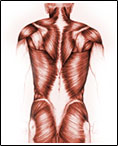
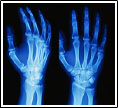
- Name skeletal, muscular and major neurological
structures in the upper extremity, lower extremity
and torso.
- Identify the structures of a skeletal muscle.
- Describe how a skeletal muscle contracts using
the sliding filament theory.
- State and give examples of length-tension
relationship, force-velocity relationship and
line of pull.
- Define and give examples of concentric, eccentric,
isometric, isotonic and isokinetic contractions.
- Define and give examples of agonists, neutralizers,
antagonists, and cocontraction.
- Name the major components of the nervous system
(central nervous system, afferent and efferent
peripheral nerves).
- Name and identify the parts of a muscle and
its nerve supply.
|
|
|